Animal Riddles and Puzzles: A Fun Way to Learn

Animal riddles and Paslapties Kodas puzzles are a simple but powerful way to bring learning, laughter, and family time together. Animals are naturally interesting to children and adults. Many people love guessing facts about dogs, cats, birds, farm animals, wild animals, and sea creatures. Because animals are familiar, funny, and full of unique behaviors, they make a perfect theme for brain games.
Riddles do not need to be complicated to be useful. A short question about an animal can make a child stop, think, compare clues, and use imagination. For example, a riddle might describe an animal by its sound, movement, home, food, or special skill. To find the answer, the player must listen carefully and connect different pieces of information.
Why Animal Riddles Are Great for Learning
Animal riddles help children learn in a natural and playful way. Instead of memorizing facts, children discover information through guessing and problem-solving. This makes learning feel like a game rather than a lesson.
For younger children, animal riddles can improve vocabulary. They learn words related to size, color, sounds, movement, habitats, and body parts. For example, they may learn that a bird has wings, a fish has fins, a dog barks, and a horse gallops. Older children can enjoy more difficult riddles that include logic, wordplay, or unusual animal facts.
Brain Benefits of Puzzles and Riddles
Puzzles and riddles can support many important thinking skills. They train attention, memory, logical thinking, creativity, and patience. When someone tries to solve a riddle, the brain must focus on the clues and ignore answers that do not fit.
This process is useful for both children and adults. Children develop problem-solving skills, while adults get a fun mental exercise. Riddles can also help people practice flexible thinking. Sometimes the answer is not the first idea that comes to mind, so players must look at the question from another angle.
Examples of Simple Animal Riddles
Here are a few easy animal riddles that families can try:
I have four legs, I wag my tail, and I love to bark. Who am I? Answer: a dog.
I can fly, I have feathers, and I build a nest. Who am I? Answer: a bird.
I live in water, I have fins, and I swim all day. Who am I? Answer: a fish.
I am small, I like cheese, and I can run very fast. Who am I? Answer: a mouse.
I am big, grey, and I have a long trunk. Who am I? Answer: an elephant.
More Paslapties Kodas puzzles and brain teasers→
A Screen-Free Activity for Families
Many families are looking for simple ways to spend less time with screens. Animal riddles and puzzles are a great option because they need little or no equipment. They can be played at the dinner table, in the car, during a walk, before bedtime, at a birthday party, or on a rainy afternoon at home.
This type of activity encourages real conversation. Parents, children, grandparents, and friends can all take part. One person can read the riddle, while others try to guess the answer. The game can be calm and cozy, or it can become funny and energetic depending on the group.
Playing with Children
When playing animal riddles with children, it is important to choose questions that match their age. Very young children need simple clues and familiar animals. A riddle about a cat, dog, cow, duck, or rabbit is easier than a riddle about a rare wild animal.
Older children can enjoy more challenging questions. They may like riddles about animal behavior, habitats, food chains, migration, or unusual survival skills. If a child does not know the answer, parents can give small hints instead of saying it immediately. This keeps the child thinking and helps build confidence.
Playing with Friends or at Parties
Animal riddles can also be used as a fun group activity. At a children’s party, guests can be divided into teams and asked to solve animal-themed riddles together. Each correct answer can give a point, a clue, or a small reward.
This works especially well for animal-themed birthdays, classroom activities, family gatherings, or pet-loving groups. The game can include easy riddles, funny questions, drawing challenges, animal sounds, or movement tasks where players must act like the animal they are guessing.
Animal Puzzles and Creativity
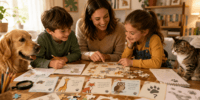
Animal puzzles do not have to be only verbal riddles. Children can also draw an animal from clues, build an animal from blocks, match paw prints to animals, create a simple treasure hunt, or invent their own riddles. Creating a riddle can be even more educational than solving one because the child must think about what makes an animal unique.
For example, a child might choose an owl and describe it without saying its name: it flies at night, has big eyes, and says “hoo.” This helps the child practice observation, description, and communication skills.
Riddles Help Build Confidence
One of the best things about riddles is the feeling of success when the answer is found. For children, this moment can be very motivating. It shows them that thinking carefully can lead to a solution.
Even wrong guesses can be useful. They teach children that making mistakes is part of learning. When a child tries again, listens to more clues, and finally finds the answer, they practice persistence in a fun and safe way.
Using Animal Riddles for Education
Animal riddles can be used in many learning situations. Teachers can use them to introduce a lesson about habitats, pets, farm animals, or wildlife. Parents can use them to support reading, speaking, and thinking skills at home.
Riddles can also lead to deeper conversations. After solving a riddle about a penguin, children may ask why penguins cannot fly or how they live in cold places. After a riddle about bees, they may want to learn about flowers, honey, and pollination. In this way, a simple game can become the beginning of real curiosity.